
Why Audience-First Organizations Align People Before They Connect Channels
A fundraising leader recently shared a story with me that I haven’t been able to shake. Shortly after making a transformational seven-figure gift, a donor received a generic email appeal asking them to give $100. Rather than ignoring the message, the donor contacted the organization to ask what had happened. Had their gift been received? Did anyone know they had made it? Why, after making such a significant commitment, were they receiving what felt like a mass fundraising appeal?
Most of us have heard some version of this story. We tend to explain these moments away as automation failures, outdated mailing lists, disconnected systems, or bad data. Those explanations are reassuring because they suggest the problem is technical—and therefore solvable. Fix the integration. Clean up the data. Adjust the workflow. While those things certainly matter, they don’t explain why stories like this continue to happen.
Somewhere within that organization, people knew full well the donor had made a transformational commitment. Somewhere else, another team was faithfully executing the next campaign on the calendar. Neither group intended to create a poor experience. In fact, both were likely doing exactly what the organization had asked them to do. The donor, of course, had no visibility into any of that. They experienced one organization that didn’t seem to recognize that the relationship had fundamentally changed.
That’s why this isn’t really a technology story. It’s a leadership story.
The Myth of the Connected Experience
Over the past decade, nonprofits have invested heavily in technologies designed to create more connected constituent experiences. CRM platforms have become more sophisticated. Marketing automation has matured. Customer data platforms promise a unified view of the constituent. Artificial intelligence is helping organizations personalize communications, predict giving behavior, and recommend the next best action.
Those investments have fundamentally changed what’s possible. Organizations have more data, more channels, and more opportunities to engage supporters than ever before. Yet stories like the one above continue to happen with surprising regularity.
The reason is that connected technology doesn’t automatically create connected experiences.
Technology is extraordinarily good at connecting systems. It can consolidate constituent records, automate communications, identify patterns in behavior, and recommend what to do next. What it can’t do is create shared priorities across departments. It can’t decide when stewardship should take precedence over solicitation. It can’t resolve competing objectives between fundraising and marketing, or determine who owns the relationship at a particular moment. Those aren’t technology decisions. They’re organizational decisions.
Too often, organizations expect technology to compensate for a lack of alignment. When the donor experience falls short, the instinct is to look for another integration, another platform, or another automation. Sometimes those investments are necessary. More often, they’re being asked to solve a problem that begins long before technology enters the conversation.
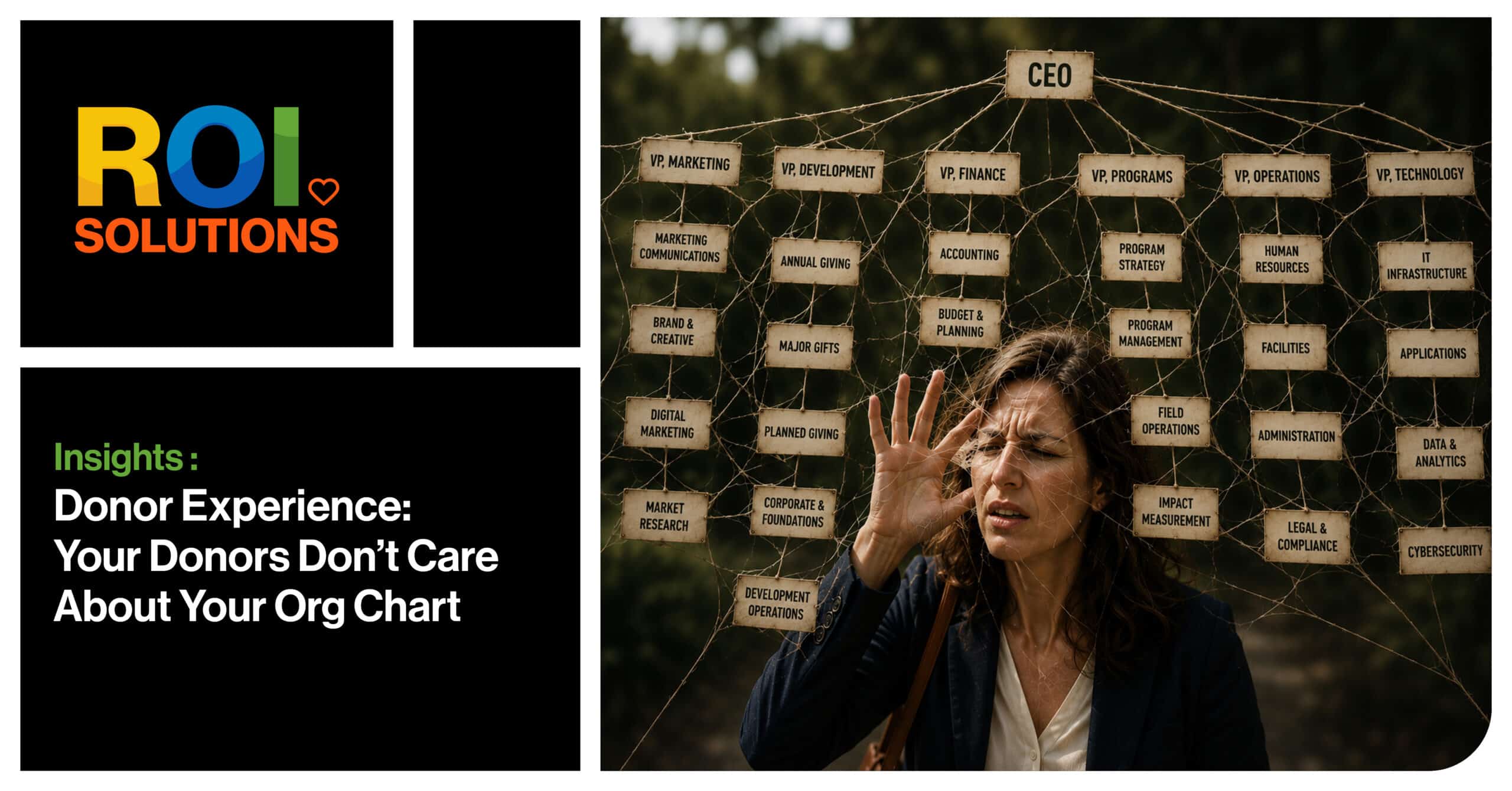
Every Org Chart Creates Blind Spots
There’s nothing inherently wrong with an organizational chart. As nonprofits grow, specialization becomes essential. We need marketers who understand audience engagement, fundraisers who build relationships, analysts who interpret data, digital teams that optimize online experiences, and constituent services professionals who respond when supporters have questions. Dividing work this way creates expertise, accountability, and scale.
The challenge is that donors don’t experience organizations the way organizations experience themselves.
A donor doesn’t distinguish between annual giving and major gifts. They don’t know whether a message originated with the marketing team or the development office. They don’t care which system generated the email, who approved the copy, or which department owns the campaign calendar. Every interaction contributes to a single relationship with a single organization, and they naturally assume those interactions are connected.
Inside the organization, however, each department quite reasonably focuses on its own responsibilities. Marketing measures engagement. Fundraising measures revenue. Digital teams optimize conversions. Constituent services emphasizes responsiveness. Each objective makes perfect sense on its own, but none of them fully reflects the donor’s experience.
Every org chart creates blind spots. That’s not a criticism of organizational structure; it’s simply the reality of specialization. Departments see constituents through the lens of their own responsibilities because that’s how work gets organized. Leadership’s job is to ensure someone is looking across the entire relationship.
Without that broader perspective, organizations can unintentionally create disconnected experiences while every department believes it’s succeeding. Supporters receive repetitive communications. Opportunities for stewardship are missed. Messages compete with one another instead of reinforcing one another. And occasionally, a donor who has just made a transformational commitment receives an email asking for another $100.
The email isn’t the real problem.
It’s simply the first visible symptom of an organization that hasn’t adjusted to a relationship that has fundamentally changed.
Audience-First Organizations Align People Before They Connect Channels
Much of the conversation around omnichannel fundraising focuses on coordinating channels. How should email support direct mail? How does digital advertising complement major gift outreach? Where do text messaging, events, and social media fit into the journey?
Those are worthwhile questions, but they begin one step too late.
Audience-first organizations align people before they connect channels.
That alignment starts with a shared understanding of the constituent. It requires agreement about what meaningful engagement looks like, how different interactions should influence future communications, and what success means across departments—not just within them. Instead of asking, “What campaign should we send next?” organizations begin asking, “Given everything we know about this relationship, what should happen next?”
That subtle shift changes almost everything.
Data becomes more than a source of reports and dashboards. It becomes the common language that allows marketing, fundraising, analytics, constituent services, and leadership to understand the same constituent in the same context. Rather than reinforcing departmental perspectives, data helps create a shared perspective—one that makes better decisions possible before the next campaign is launched.
Technology takes on a different role as well. Instead of being expected to solve organizational challenges, it enables decisions that people have already agreed to make. Automation scales those decisions. AI helps refine them. Integration ensures they’re executed consistently. But the decisions themselves still begin with people who share common objectives and a common understanding of the relationship they’re building.
Organizations that consistently deliver exceptional donor experiences rarely do so because they have the newest technology. They do so because their people are aligned around the same constituent, the same goals, and the same definition of success.
Before the Next Technology Investment
The nonprofit sector will continue investing in AI, automation, predictive analytics, and increasingly sophisticated engagement platforms—and it should. These technologies represent extraordinary opportunities to better understand constituents, personalize engagement, and improve fundraising outcomes. But before evaluating the next platform or capability, it may be worth asking a different question: Is the organization aligned around the relationship it is trying to build?
Consider the donor who questioned the $100 appeal. The technology didn’t fail. In many respects, it worked exactly as it had been configured to work. A campaign was scheduled, an audience was selected, and a message was delivered. The problem wasn’t that the organization lacked technology; it was that the organization hadn’t adapted to a relationship that had fundamentally changed. One team understood the significance of the donor’s commitment, while another continued executing the next campaign as planned. The donor experienced neither of those internal realities. They experienced one organization that didn’t seem to know who they were.
That distinction matters because technology is remarkably good at helping organizations execute decisions, but it cannot make those decisions for them. It cannot establish shared priorities across departments, determine when stewardship should take precedence over solicitation, or create agreement about what the next interaction with a donor ought to be. Those are leadership responsibilities, and they require people to share a common understanding of the constituent and the relationship they’re trying to build.
As nonprofits continue to pursue more personalized, audience-first fundraising, organizational alignment may become an even greater competitive advantage than technology itself. Platforms will continue to evolve, AI will become more capable, and new channels will emerge. The organizations that consistently deliver exceptional donor experiences, however, will be the ones that have aligned their people, processes, and data around a shared view of the constituent before asking technology to scale that work.
Your org chart will always determine how work is divided internally. It should never determine how your donors experience your mission. Every interaction either reinforces or weakens the relationship you’ve worked so hard to build, and donors don’t evaluate those interactions one department at a time. They experience them as reflections of a single organization.
In the end, the donor who questioned the $100 appeal wasn’t really asking about an email. They were asking a much more fundamental question: Do you know who I am? Every organization answers that question with every interaction. The goal isn’t simply to connect channels. It’s to ensure that the people behind those channels are aligned well enough that the answer is always yes.
Have you had a recent experience like this? Let’s Talk
Key Takeaways
- Nonprofits often fail to provide a cohesive donor experience due to departmental disconnects, not just technical issues.
- The concept of connected technology doesn’t guarantee connected experiences, as alignment among staff is crucial.
- Audience-first organizations focus on aligning people and objectives before integrating channels to enhance donor relationships.
- Organizational charts create blind spots, leading to misaligned communications and missed stewardship opportunities.
- A successful approach prioritizes shared understanding of constituents, fostering cohesive decision-making and exceptional donor experiences.